History of Oakdale Cemetery

Oakdale Cemetery was chartered on December 27, 1852 by the General Assembly of North Carolina. The founders purchased 65 acres for $1,100. The acreage now has grown to about 100 acres of natural beauty. Created during the era of the Rural Cemetery Movement in the US, Oakdale was the first in the state, only fitting for the most populous city in the state at the time. It was five blocks beyond the town boundaries.

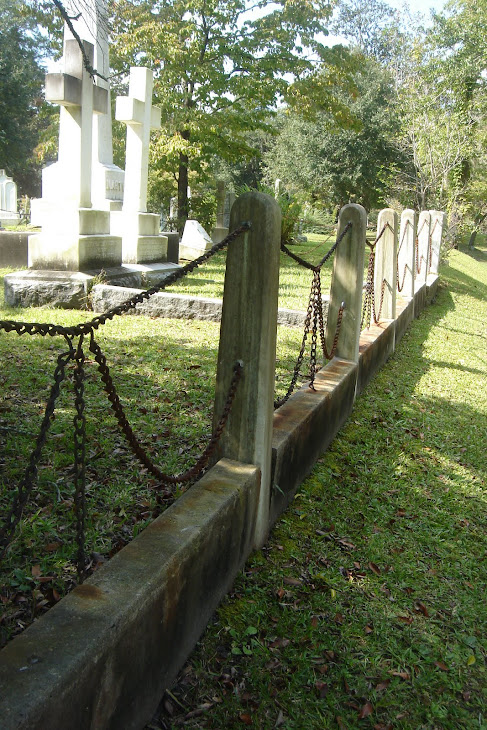
Old Iron Chain Fence

Old Iron Chain Fence
Showing posts with label civil war history. Show all posts

Tuesday, April 10, 2012

The Trask Family History


Who are the Trasks?
By: Ben Steelman
Star News

Trask Family Plot, Oakdale Cemetery Wilmington NC 
A family of farmers, businessmen and civic leaders, the Trask family left its mark on New Hanover County for more than a century and a half. Pioneers in the lettuce and truck farming industry, they later switched to growing subdivisions and shopping centers on their land — and, in the process left their name on a number of local landmarks.

The patriarch of the clan, Daniel Webster “Web” Trask (1847-1930) was born into a relatively poor farming family in the Masonboro Sound area of New Hanover County. He served in the Masonboro Militia, a Home Guard unit, in the latter days of the Civil War and made his start growing cabbages and collards on Prospect Hall farm, which he inherited from his mother.

A compulsive reader of farm magazines, Web Trask had the idea to cover his beds — first with boards and later with cheesecloth — to protect his plantings, so he could get his produce to market two or three weeks earlier than anyone else’s. By 1890, his crop was so big, he shipped his surplus north on the Atlantic Coast Line railroad and began to cultivate buyers in New York and elsewhere.

The Trask produce business would really take off, however, under Web’s son George W. Trask (1876-1963). A hard worker, the younger Trask started off around 1897 with a small farm, Blythe Savannah, in the Winter Park community. (His chidren later joked that it was neither blythe or a savannah.)

In 1902, however, with money borrowed from his father, George Trask bought a farm in the Wrightsboro community, close to the Atlantic Coast Line tracks, from his uncle Christian H. Heide (who suffered from tuberculosis and wanted to move to the North Carolina mountains for his health).

Within two years, George W. Trask had paid off his father, and by 1907, he could afford to have Wilmington architect Henry Bonitz build a spacious farmhouse for his family — later known in family lore as “The Big House.” Carefully investing his profits, he steadily bought more land, until the family tracts amounted to thousands of acres. Bringing in his sons as partners, he founded George W. Trask & Sons to handle the northern export business. By the time of his death, his obituary in the Morning Star hailed him as “the first commercial planter of field green lettuce on the Eastern seaboard.”

In his spare time, George W. Trask served as a New Hanover County Commissioner from 1918 to 1950. He and his wife, Emma Gertrude McEachern Bornemann Trask, had 11 children and left 32 grandchildren and 23 great-grandchildren.

Among George Trask’s children was C. Heide Trask (1902-1957), who followed his father into the family business and worked intensively on refrigerating produce. C. Heide Trask was chairman of New Hanover County’s Selective Service (draft) board, 1940-1955, and was chairman of the board of James Walker Memorial Hospital. At the time of his death, he was a member of the State Highway Commission. One of his major accomplishments was pushing through the drawbridge over the Intracoastal Waterway to Wrightsville Beach, which was named in his honor when it opened in 1958.

Trask High School in Pender County is also named for C. Heide Trask; the Trask family donated land for the school’s campus.
Another of George W. Trask’s sons was Raiford Graham Trask (1916-1993), who ended up leading the family in new directions. He developed a number of Wilmington subdivisions on former Trask farmland, including College Acres, Long Leaf Acres and Kings Grant, and he was co-developer of Figure Eight Island and the Duck Haven Golf Club. He also built several shopping centers.

Like others in his family, Raiford Trask entered politics. He served on the Wrightsville Beach Town Council and was mayor of Wrightsville Beach, a New Hanover County Commissioner (1952-1956) and a trustee of Wilmington College for 10 years. He donated much of the land for the present campus of the University of North Carolina Wilmington (and sold much of the rest to the college at bargain rates). Trask Coliseum on the UNCW is named in his honor. In 1973, Raiford Trask donated large tracts of land to the New Hanover County school system. Trask Middle School is named for his mother.

Many members of the Trask family are buried at Wilmington’s Oakdale Cemetery. The family monument is decorated with carvings of cornstalks and lettuce heads, sources of much of the family’s prosperity.

“The Trask Family — 1986″ by George Graham Trask provides much genealogical data, and “The Carolina Trasks” by Frederick Graham Trask offers family history and stories. Both books are available for study in the local history room of the New Hanover County Public Library, 201 Chestnut St., Wilmington [Map this].
Date posted: June 3, 2009
User-contributed question by:
Linda Rooks Richardson

Sunday, March 25, 2012

Famous People Buried at Oakdale Cemetery


Famous People Buried at Oakdale Cemetery

David Brinkely
Birth: Jul. 10, 1920
Wilmington
New Hanover County
North Carolina, USADeath: Jun. 12, 2003
Houston
Harris County
Texas, USA
Television Personality/Newscaster. Brinkley was born on July 18, 1920, in Wilmington, North Carolina. He was a main fixture on television for over 50 years including on NBC and ABC, beginning his career as a broadcaster in the 1940s. Appearing as a co-anchor with Chet Huntley on the news program, "The Huntley-Brinkley Report" from 1956 to 1970, and "This Week With David Brinkley" from 1982 until he retired in 1997. In 1992 he won the George Foster Peabody Award for his report on the 50th anniversary of the Japanese attack on Pearl Harbor on December 7, 1941, during World War II. He also appeared as a narrator on the 1961 film, "The Challenge of Ideas" and as himself in an episode of, "The Jack Benny Program" on September 25, 1964. He was well-known to television audiences as a news analyst for his terse, biting comments and dry wit. He was also the recipient of two more George Foster Peabody Awards, 10 Emmy Awards, and the Presidential Medal of Freedom, the highest civilian honor. In 1995 he wrote his memoirs, "11 Presidents, 4 Wars, 22 Political Conventions, 1 Moon Landing, 3 Assassinations, 2,000 Weeks Of News, and Other Stuff On Television." He retired from broadcasting in 1997. He died June 11, 2003, at the age of 82, after a fall at his home in Houston, Texas. (bio by: K)

Family links:
 Parents:
  William Graham Brinkley (1875 - 1928)
  Mary West Brinkley (1879 - 1966)


Search Amazon for David Brinkley Burial:
Oakdale Cemetery
Wilmington
New Hanover County
North Carolina, USA
Maintained by: Find A Grave
Record added: Jun 12, 2003
Find A Grave Memorial# 7567008

John Dillard Bellamy
Birth: Mar. 24, 1854
Wilmington
New Hanover County
North Carolina, USADeath: Sep. 25, 1942
Wilmington
New Hanover County
North Carolina, USA
US Congressman. Bellamy was a member of the North Carolina State senate from 1900 to 1902. He served as a U.S. Representative from North Carolina from 1899 to 1903. (bio by: Evening Blues)

Family links:
 Spouse:
  Emma May Hargrove Bellamy (1857 - 1944)*

 Children:
  Eliza M Bellamy Williamson (1877 - 1969)*

*Calculated relationship


Search Amazon for John Bellamy Burial:
Oakdale Cemetery
Wilmington
New Hanover County
North Carolina, USA
Maintained by: Find A Grave
Originally Created by: Evening Blues
Record added: Nov 07, 2003
Find A Grave Memorial# 8067171

Saturday, March 24, 2012

Group Tour Discounts

Coming to Visit Historic Wilmington, North Carolina this summer? Tour Group Discounts. 5 Star Story Tellers!

Always a good Day for a Haunted Cotton Exchange or a History Walking Tour!
Group Discounts with 10 or more, age 12 and under FREE with adult.  Great for bus tours groups, clubs,schools, family reunions, company outings, fund raisers..
Fun for the whole family!
Call for Tour Times
Call 910-409-4300

Saturday, March 17, 2012

Henry Bacon

Henry Bacon

Henry Bacon was the architect for the Lincoln Memorial in Washington DC and the Bellamy Mansion on Market and 5th Ave in Wilmington.  He is buried in Oak Dale Cemetery

Source: A Pictorial History of Wilmington by Anne Russell

Henry Bacon, Jr. (Nov. 28, 1866-Feb. 16, 1924), best known as the architect of the Lincoln Memorial in Washington, D. C., spent much of his youth in Wilmington, North Carolina, and he designed some notable buildings in the state as a result. The friendships he made in Wilmington as a youth led to several commissions in Wilmington and Linville, a mountain resort established by Wilmingtonians. In contrast to his predominantly classical designs for which he is generally recognized, his little-known North Carolina work displayed his artistic approach to an informal, rustic architecture suited to coastal and mountain settings.

Henry Bacon, Jr., was born in Watseka, Illinois, one of seven children of Henry (1822-1891) and Elizabeth Kelton (1831-1912) Bacon of Massachusetts. In the 1870s Henry, Sr., a civil engineer, moved the family to the Wilmington area. He had been assigned to the Wilmington office of the United States Engineer Department to take charge of construction of the great New Inlet Dam and Swash Defense Dam near the mouth of the Cape Fear River, a major engineering feat (see Bishir and Southern, A Guide to the Historic Architecture of Eastern North Carolina). The family lived in Southport from 1876 to 1880 and moved to Wilmington in 1880.
After graduating from Wilmington's Tileston School in 1884, Henry Bacon, Jr., attended architectural school at the University of Illinois for a year, worked in a Boston architectural office, and then moved to the prestigious New York firm of McKim, Mead and White. He was involved with that firm in planning for the Chicago World's Fair of 1893. Subsequently, in partnership with the noted architect James Brite and then on his own, Bacon gained widespread respect and many honors as an architect in the Beaux-Arts tradition. His Lincoln Memorial (1912-1922), for which he won the prestigious Gold Medal of the American Institute of Architects, was by far the most famous of his works, which included important campuses, public buildings, and, in keeping with Beaux-Arts principles, memorials in collaboration with premier sculptors of the day.
Bacon maintained contact with family and friends in Wilmington, including his sister Kate Bacon McKoy. (He suggested a design for a house in Wilmington for Kate and her husband, but the couple chose another plan, which was built by local architect-builder James F. Post.) Although his oeuvre tended toward monumental classical designs, for friends from Wilmington he planned buildings in more informal styles. He designed the Donald MacRae House (1902) in Wilmington in a picturesque Queen Anne-Shingle style. Beyond the city beside the sound, he designed Live Oaks (1913), an octagonal villa for Walter and Agnes MacRae Parsley, wherein he employed a local shell-rock material.

When the Wilmington MacRae family and others developed the mountain resort village of Linville, Bacon designed some of its earliest buildings in an elegant rustic mode suited to the mountain setting. Using the abundant local chestnut bark and natural branches in artful fashion, he planned All Saints Episcopal Church (1910-1913), for which Agnes MacRae Parsley of Wilmington was a major donor. He also designed at least three cottages in similar style. His use of natural chestnut shingles and sheathing inside and out set a local pattern for the distinctive resort community, a mode that continued until the chestnut blight wiped out the great trees.
Bacon also designed two notable memorials in North Carolina: the Women of the Confederacy Monument (1913) on Union Square in Raleigh, with sculptor Augustus Lukeman; and the Gabriel James Boney Confederate Monument (1924) in Wilmington, completed after his death, with sculptor Francis H. Packer. At his death in 1923, Bacon was buried in the family plot in Wilmington's Oakdale Cemetery; his marker was designed after a classical drawing found on his desk. Although not often recognized in larger studies of Bacon and his contemporaries, for Bacon his Wilmington-related friendships and projects were an important part of his oeuvre and his life. A state highway historical marker in Wilmington, one of the few (possibly the only one) in the state memorializing an architect, recognizes his presence and work in the city.
Author: Leslie N. Boney, Jr. Update: Catherine W. Bishir.
Published 2009
)

Ghost @ Paddy's Hollow

Fred the Ghost Wilmington NC

Welcome to Tour Old Wilmington's new blog site!

Fred the Ghost, pictured below is a great example of local spooky lore.

I took this picture in Paddy Hollows located in The Cotton Exchange in beautiful downtown Wilmington NC. It was about 4:oo pm in the afternoon. I had just finished talking to the bartender about the possibility of ghost haunting the old place. Goofing around, I took several pictures. In this one you can see the face of Fred the Ghost.
He is said to haunt the bar and loves to pull practicaljokes on the restaurant staff.